Revenants
Publication for photography exhibit at the Akureyri Museum of Art, December, 2001.
The phantoms suggested by the title of Katrín Elvarsdóttir's series, Revenants, are of a different variety than the spectres that might float through a keyhole. The ghosts glimpsed in her photographs have more to do with things left behind to memory—earthly things, perhaps, but just as haunting. The items or places are inert, yet it is as if they radiate with some last vestige of emotion—a last gasp of imparted spirit. The landscapes, originated on archaic equipment barely more advanced than a pinhole camera, hark back to the earliest era of photography. The territory is of a rural Iceland whose inhabitants have died out or moved on to better prospects, a condition not uncommon to many parts of the world, the cause being anything from industrialization, to climate change. The result is that the environments depicted could be of any high latitude, whether the post-Soviet Union, Labrador, or Patagonia. But because it is Iceland, the ghosts implied within the title are specific to their own culture. The Icelanders themselves may be re-established in Reykjavík or on extended trips around the world. But the folklore remains among the ruins, as if the previous generations left behind a sediment of emotion that has been absorbed into the soil, rendering each outcrop a sentient being. And if the Icelandic interpretation of their mythology is more literal than in other parts of Northern Europe, this would seem a logical enough proposition. Mythology has always fermented in the opaque regions just beyond sight of the campfire, or in the modern era, the zone beyond certifiable evidence. In the effort to maintain an authentic identity within the larger western industrial civilization, a link to superstition has carried over, allowing for a good amount of leeway in retaining a sense of the elves.The land is nameless, the titles of the images not so much documenting specific locations in Iceland as denoting realms no more accessible than the ether of memory.

It is in this way that the parallels exist between Katrín Elvarsdóttir's own origins and her work, as she was born in Ísafjördur in 1964, but her family relocated to Reykjavík. After a period spent abroad during her teens in Sweden, she attended the University of Iceland studying French literature, followed by an extended stay in the U.S., where her inclination shifted to photography. Out of such an environment with so many disparate instincts, Katrín's own personal sensibility resonates with an unflappable integrity. An individual artist with a distinctive body of work, she has functioned and survived within a larger, prevailing global culture, as evident in her shows during the late 1990s in Reykjavík, Florida, Denmark, and New England. Whether in photographs or collage assemblies, her imagery strikes a balance between narrative and a strong graphic instinct.In Revenants, her attention shifts back towards the territory of her origins. She has pared down her technology to the most rudimentary of 120 format cameras, reducing her choices to the essential exposure, the rudimentary optics dictating a unity within the images, with concentric degrees of illumination emphasizing innate distances as palpable and yet indescribable as any glimpse of Elysium or Beulah Land. The result is not unlike an alchemist's camera obscura capturing evidence of a place that is at once just beyond the lens but as inaccessible as the netherworld.It is indeed an ethereal heritage that Katrín has returned home to. Yet for all the prevailing themes that unify the series, there are as many elements that distinguish each individual photograph.

In the photograph "Suðurland II" (2001) the exposure evokes not so much Iceland, but a Soviet Union of secret numbered cities or forgotten gulags. As if in a surreptitious snap taken by an exile, or by remote sensing, the northern sun illuminates what could be either launching gantries or oil wells, the technology reduced by the environment to its most primitive form. And for all the light shining downward, the cold is all encompassing, even while the chimera of the spires would suggest radiation passing through them, rendering everything within the frame lifeless, the dark swath at the bottom of the image not so much earth as inert sediment.
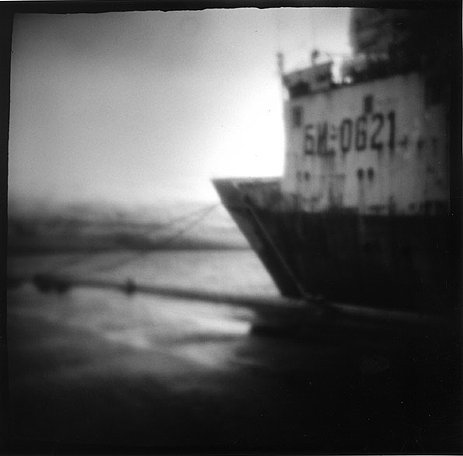
"Norðurland III" (2001) is, of course, more blatant in suggesting a Soviet/post-Soviet venue, as the Cyrillic lettering on the ship's superstructure leaves little doubt as to its origin. The connection between the two worlds would seem logical enough, the shore being on the edge of the abyss, the Arctic beginning just beyond view. Whatever comes from over the horizon, whether Russian freighters, Siberian driftwood, Maersk containers, crates of oranges, or Algerian corsairs, their influences are deposited with the currents, forgotten a month later, but remembered for generations.
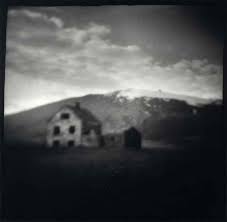
"Snæfellsnes" (2001) with its emptied house and connected outbuildings sitting at the foot of a glaciated mountain, the disposition of the sky and the line of the mountain carries a homely trace. As if harking back to the idyll of a silent film epic, the site resembles an archaic redoubt, however the substance, structure, and size of the ruin would indicate a fairly recent past. With its asymmetrical lines and lopsided cavities, the decrepitude is all pervasive — the former occupants having either perished or moved on to a more sustainable existence, as if the region as been formally de-incorporated and declared an empty quarter, abandoned to the hinterlands.
In "Strandir II" (2000) the wreckage of the grounded ship, devoid of any masts or deck structure, righted only by an external framework, has merged with the land and the harbor, forming an inadvertent promontory. The hull, although still solid, would appear to have been picked clean by salvagers, its crew having disembarked more or less in safety to the shore. It is a sight reminiscent of the Falklands Islands and other high-latitude outposts, with generations of working ships beached and written off rather than venture further into treacherous seas. Any sense of memorializing seems happenstance, no plaques being necessary, the long, sculptural lines of the hulk itself serving as enough of a monument.

"Norðurland II" (2001) with its surplus Quonset Hut and mid-sixties Oldsmobile carries over to what now seems as much a mythic era in that it could be called "Middle Cold War." The iconography of both the hut and car scream of a shabby American nostalgia, and unlike the previous images, it is not an abandoned site. The light above the car is on, glowing faintly, and there are no uneven traces of debris in the foreground, just a sparse functionality of the environs. But at most, there would seem to be only a skeleton shift in a workshop, the machinery idling during a summer dusk, the American influences counting as a decorative layer already settling back into the earth.
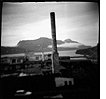
"Strandir I" (2000) it is not clear if the factory overlooking the span of water, like the previous image, is a derelict or is functioning on some basic level, as a faint wisp of vapor emanating from the chimney appears to mimic the low-hanging cloud in the harbor. But it is the barest sign of life, as the right angles of the building settle into a foreground that is as opaque as volcanic ash – a parked car rendered a faint, half-submerged shape, lost among the murk. With its smudged cement surfaces, worn by time and the elements, it is hard to image the factory ever having supported itself so far on the periphery of any larger economy. Its only apparent link is the water and the narrow causeway and winding road on the right, and yet it might be purely illusionary, as if faces could be glimpsed in the detail as well. All that remains amidst the composition and the interplay of light is that the structure remains, the smokestack still reaching upward, almost a monument, a rust-belt obelisk."
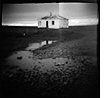
"Að Norðan" (2000) sits under a shroud of overcast, the solitary stucco cottage reflected in a mudpuddle. It could be Ireland or straight out of the remembered potato fields of Günter Grass's Kashubia, and somehow, as if by virtue of its placement within the frame, the cottage evokes a grandmotherly presence, left behind to a hardscrabble existence. It is a sentimental premise, or at least a projected sentiment, as the gulf between the comfortable, reflective present and the earlier generations who tried to make a viable living off such a landscape and often failed continues to haunt as much as any specter.

That "Suðurland I" (2001) should follow "Að Norðan" makes perfect sense, for beyond the link in the weather and the rain-filled puddles, the road winding towards the horizon is no doubt escaping the isolated world of the previous image. There is no sense of arrival, only departure, as if setting off and severing ties is an inevitable fact, but the loss is undeniable. For as much as the landscape is comprehended, having been measured, divided, and worked to exhaustion, it is only upon return that the final aesthetic transformation is apparent.

If arrival is to be had, it is in "Suðurnes" (1999) the overcast of the earlier images having broken, the road having deposited the perspective––in what may belie the title ––to the edge of true North, Ultima Thule, the rough-hewn shrine serving as a marker. As much as it would seem morning, the lateness of the hour––or indeed the epoch–has been reached. It is the fact of the high latitude, the very sense of impossibility that buffets the place with a roar, and that there is indeed a palpable glory cast upon this knoll. It is a glory not dependent on the cross pushed up against the sky; the cross is simply another mythic application, another level of iconography, another visitor's interpretation. The glory is that the patch of windblown high grass and distant mountain frame a rarefied pocket where the transcendent is to be glimpsed, a point where geography and the sublime converge.
Doc Crane, December 2001.
Shadows of June
How can we see without eyes?
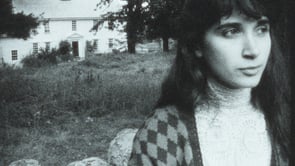
In 1919, the White Russian Princess Katerina Georgievna was ransomed and secreted to a remote farmstead in the Wachusett Forest. Betrothed to the political intriguer A.A.Richardson, the wedding never took place, and the Princess soon afterwards disappeared––the incident lost to the historic record.
As an experimental project shot in 8mm negative by the Cambridge staff of then-Super8 Sound, the film was an initial test of the pre-market 50 and 500 ASA film-stocks as well the just-released Steadicam JR system.

February 17, 1919
My Dearest Sir,
H.H. Katerina Georgievna has been sent from her reclusion in Sweden to a new location that must remain undisclosed for her future safety, as she is one of the few remaining descendants of the First Czar Nicholas. An intermediary, Mr. Epstein has been dispatched from Boston City to serve as translator and negotiator regarding the terms of her engagement.
Please understand that Mr. A. Arthur Richardson has gone to great expense to secure her release from the Insurrectionists, making sure that her passage incognito on the S.S. Dumonia was as comfortable as circumstances would allow. He is a man of great generosity, but you must understand he reserves the right to negate the betrothal if her titles, honors, and dignities are not ultimately assigned to him.
If that proves to be his decision, arrangements will need to be made for her dispensation at a later date, to be determined by Mr. Richardson.
Most Sincerely,
Jens Ulbricht Mogenssen

June 2, 1919
My Dearest Sir,
Mr. Epstein has informed me that on the 30th of May he traveled to the location where Katerina Georgievna is secluded. He states that the residence is far more rustic than one would expect for someone of her position, with no official retainers, and only one servant to cook and a bodyguard tasked as a groundskeeper. According to Epstein, a great informality has transpired, as the princess left instructions for him to be received not in the hall of the Manse, but in a meadow that she now frequents. Although her bodyguard Captain Wilmar has described the princess as melancholy and given to long walks in the forests that surround the sanctuary, Epstein states that he was graciously received and was offered far more courtesy than someone of his station would expect.
Please refer to the photographs provided by Captain Wilmar, as per Mr. Richardson’s request regarding the conduct of Epstein’s audience with the Princess.
Most Sincerely,
Jens Ulbricht Mogenssen

June 15, 1919
My Dearest Sir,
Mr. Epstein has reported that he has had a second and third visit with the Princess Nina Katerina Georgievna and they have extended discussions regarding the details of her wedding to Mr. Richardson. Because of the danger posed by Bolshevists keeping watch on public venues, the arrangement had been to use the Roman Chapel once used by the estate’s Irish servants. The Princess has asked for an Orthodox prelate to perform the Russian rituals, although there has been some difficulty determining whether the chapel will be suitable, or whether a Russian cleric can be obtained, as none so far have been willing to communicate with Epstein.
Otherwise a tentative date has been suggested, pending word from Mr. Richardson, who is currently in Habanna, and has still has not indicated if he will agree to anything other than an Episcopal service.
Most Sincerely,
Jens Ulbricht Mogenssen

June 23, 1919
My Dearest Sir,
A date has been set. I have received word from Mr. Richardson that he has agreed to the terms Mr. Epstein negotiated with H.H. Katerina Georgievna and that he will arrive on July 1st for a wedding service within the Roman chapel. Apparently Mr. Richardson has located an ordained Russian Orthodox cleric in Newark who is willing to perform the rituals. The Princess is to depart with Mr. Richardson to his family estate on the Hudson on the same day. Mr. Richardson is satisfied with the title of Count, although the domains he has been granted are at present still controlled by Latvian freikorps.
Captain Wilmar is reported to be having private communications with Mr. Richardson regarding the rapport observed between Mr. Epstein and the Princess, and it has been suggested by Mr. Richardson that given Mr. Epstein’s excellent references and services rendered, he should now be sent to negotiate with the Latvians.
Most Sincerely,
Jens Ulbricht Mogenssen

July 18, 1919
My Dearest Sir,
I regret to inform you that no wedding has transpired between Nina Katerina Georgievna and Mr. Richardson.
The Princess waited at the Roman chapel as agreed on the morning of July 1st, however is was not until the Ninth of the month that word arrived of Mr. Richardson’s marriage in the Adirondacks to the motion picture actress Madge Kimball. We have received no word from Mr. Richardson regarding any dispensation or arrangements on behalf of the Princess, and Captain Wilmar has apparently left the estate on the day his salary ended. Mr. Epstein has inquired on behalf of the Princess, and I am at a loss as to how best to advise him. Please contact me and advise whether she should be returned to Europe or if the are any other contacts who can offer her safe passage.
Most Sincerely,
Jens Ulbricht Mogenssen

September 3, 1919
My Dearest Sir,
I received word from Mr. Epstein that he traveled to the estate in the Wachusett Forest where Katerina Georgievna had been in seclusion, but was unable to locate her. It is not clear if whether she left on her own or if she has been taken by Bolshevists, given the circumstances of Captain Wilmar’s recent death. The housekeeper has taken up a new position and has sent Mr. Epstein a telegram believing that the Princess is still on the grounds, and waiting for word from her family.
In any event, our agency has concluded it arrangements with the White Russian Legation and Mr. Epstein is no longer in our employ. Please be informed that our New York office has initiated legal action against Mr. A. Arthur Richardson on several counts, and we offer you our counsel should you desire to co-litigate.
Most Sincerely,
Jens Ulbricht Mogenssen

How can we see without eyes?
hear without ears?
feel without fingers or a heart?
How can we remember when there is nothing left–
When history itself has forgotten,
is the soul left blind and deaf,
alone in the dark?
For those who come after,
who see a sun in a different part of sky,
who experience what we could scarcely imagine,
we are of different realms, separated by a gulf of years.
And yet…
Tales of the New English
Tales of the New English was a feature film project shot between April 1984 and March 1988.
Set in 1677 Plymouth Colony in the aftermath of King Phillip's War, the story follows the travels of Isaac Harlowe, a destitute farmer's son from the Outer Cape, and Rupert Greenwich, an aristocrat sent from London to investgate the whereabouts of a Regicide--one of the Puritan Judges who condemned Charles I after the English Civil War.
Determined to "better his prospects," Isaac Harlowe leaves his family's impoverished farm in Eastham to seek out his uncle in Scituate, Sebastian Entwistle, a wealthy merchant with suspected Royalist connections.
Matt Fallon as Isaac Harlowe (right) and Bill Barnard as Sebastian Entwistle


By the 1670s, Scituate was the wealthiest town in Plymouth Colony, its economy dominated by a handful of shipowners and merchants known as "The Men of Kent." One of them is Sebastian Entwistle, whose worldly Dutch and English trading connections and presumed Royalist sympathies, is viewed with suspicion by the Puritan authorities. And when the war forces inland settlers to take refuge in the port towns, Entwistle fears that the hysteria will turn towards him, and so he fills his household with displaced relatives, taking in Isaac as well.

Each town in Massachusetts Bay and Plymouth Colony was organized around a Puritan "Covenant," as their parishes were called. Each member had a designated role and position within a well-defined hierarchy. At the head of each covenant was a minister, and when the inland towns were abandoned during King Philip's War the remnants of their covenants regrouped in towns like Scituate, where their squabbling ministers formed an inquisitional "Committee."
Paul Boynton, Mario Giammarco as Reverend Ottershaw, Jeff Ginsburg, and Mark Rogers as Reverend Hammett.

Matt Fallon in a later Incarnation.

Monika Anderson and Gretchen Hopkins.

Gretchen Hopkins as Penelope, daughter of the Regicide Oliver Frye, and Tom Shillue, as a later incarnation of Isaac Harlowe.

David Prifti and Dennis Conway.

John Franklin as Mungo Macdonald.
Scottish Highlanders were brought to New England as prisoners captured after various uprisings during the 17h century. In the episode "The Papists" the newly arrived Scot attempts to escape, only to be talked down from a tree by one of the ministers Irish servants. Unknown to the ministers, the Irish Servant, Martin, is actually a Catholic Priest who tends a secret parish. This storyline was drawn from the historical precedent of a Jesuit who was discovered ministering to an underground church in Hingham in 1668.

Bob Deveau as Ensign Harry Foxe, the leader of the Militia Column sent from Scituate to recover settlers from towns abandoned during the war.

Group Shot. Tucker Stilley as Juno Finch, Bob Deveau as Ensign Foxe, Larry Blamire as Lloyd Mercer, Eric Robinson as Ian Chandler, Bill Barnum as Job Kendrick the Pedlar, Ken Skeer as the Baliff, Andy Giammarco as John Buttons, Matt Fallon as Isaac Harlowe, and Doc Crane.

Matt Fallon, Tucker Stilley, Andy Giammarco, Larry Blamire, and Bob Deveau.

Andy Giammarco as John Buttons.

Susi Alloush as a later incarnation of Penelope Frye.

Margit Baldemair as Goody Hallett.

Bob Moussavi and Gretchen Hopkins.